The Two Jobs Every Business Owner Must Learn
- Rick Slark

- Jun 19
- 3 min read
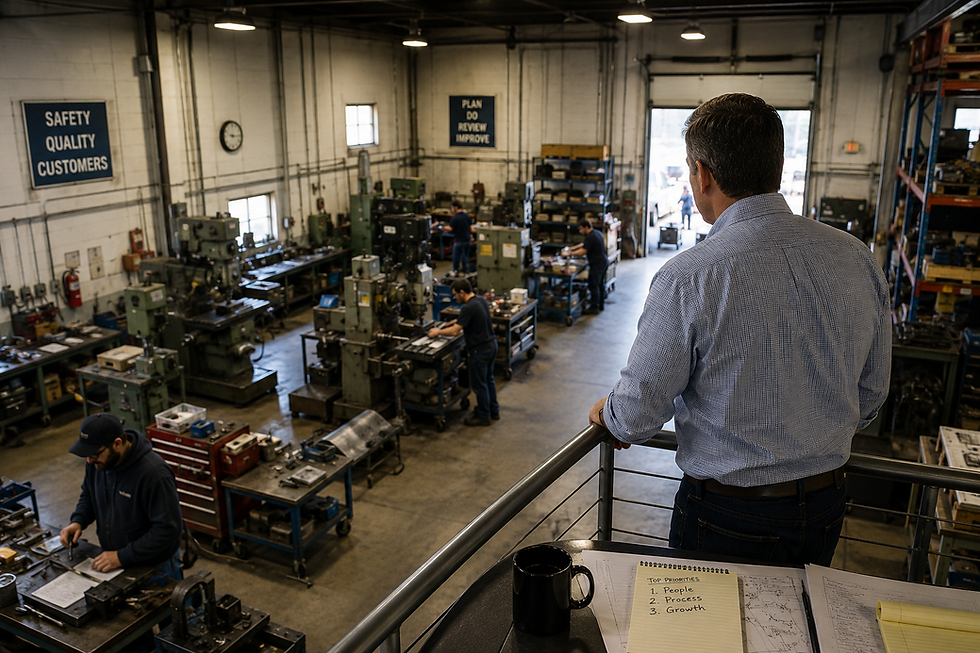
I am working out of John Kotter's book Leading Change and one observation jumped out at me.
Kotter argues that many large organizations are over-managed and under-led.
When he wrote the book, his concern was that businesses had spent decades teaching people how to manage. They taught planning, budgeting, organizing, measuring, and controlling. Those skills were necessary because organizations had become larger and more complex than ever before.
The result was that companies became better managed.
But not necessarily better led.
As I thought about that idea, I realized the challenge is a little different for most of the business owners I work with.
Most small businesses are not over-managed.
In fact, many aren't managed enough.
And they aren't led enough either.
The reason is simple.
The owner is busy doing the work.
They're meeting with customers, solving problems, preparing estimates, handling payroll, answering questions, and putting out fires. By the end of the day, they've been productive, but they've spent most of their time working in the business rather than managing or leading it.
That's understandable.
Most businesses begin that way.
A skilled technician starts a company. A consultant opens a practice. A tradesperson decides to work for themselves. An entrepreneur sees an opportunity and gets started.
In the beginning, success comes from being good at the work.
But eventually something changes.
The business grows.
Employees are added.
Customers increase.
Complexity arrives.
What worked when the owner was serving ten customers no longer works when the company is serving one hundred.
At that point, the owner's job begins to change.
The first transition is learning to manage.
Management isn't glamorous, but it's necessary. Management creates consistency. It establishes systems, processes, expectations, accountability, and structure. Good management helps ensure that customers receive the same quality experience whether the owner is present or not.
Many small businesses hit a ceiling because management never catches up with growth. The owner remains the answer to every question and the solution to every problem. The business works, but only as long as the owner is constantly involved.
Then comes a second transition.
The owner must learn to lead.
Leadership is different from management because leadership focuses on the future. While management asks how we can do today's work better, leadership asks where we are going next.
Leadership provides direction.
Management turns that direction into reality.
Leadership identifies opportunities.
Management builds the systems necessary to pursue them.
Leadership creates movement.
Management creates consistency.
The two are not competing responsibilities. They are complementary responsibilities. One without the other eventually creates problems.
An owner who focuses only on leadership can create vision without execution.
An owner who focuses only on management can create execution without direction.
The strongest businesses have both.
What strikes me is that many owners spend years trying to become better producers. Then they spend years learning to become better managers.
But the businesses that continue to grow are usually led by owners who eventually learn a third skill.
They learn how to lead.
They learn how to lift their eyes above today's work and think about tomorrow's business.
Doing the work matters.
Managing the work matters.
Leading the business matters.
They're three different jobs.
And one of the most important challenges of growth is recognizing when it's time to move from one to the next.
A Final Thought
If this article describes where you find yourself today, you're not alone.
Many business owners reach a point where they realize that working harder is no longer the answer. The next stage of growth often comes from learning how to manage the business more effectively and lead it more intentionally.
That's the work we help business owners do every day at Slark Consulting Group.
If you'd like to explore what that might look like in your business, we'd welcome the opportunity to have a conversation.


